Blog
Why Choose a Japanese Kitchen Knife – Part 1

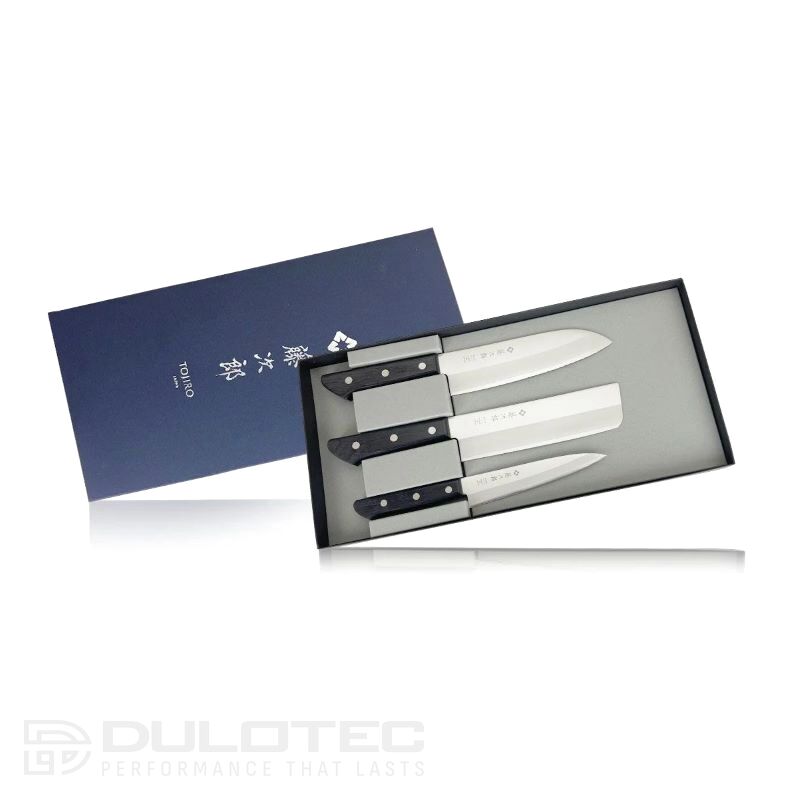
Japanese kitchen knives are famous all over the world, and in this article we'll explore why they've earned such a reputation and what types of Japanese knives there are.
The primary purpose of a kitchen knife is to cut well, something the Japanese have elevated to a cult status. From the cheapest to the most expensive knives, a clean cut is the manufacturers’ main goal. This is achieved by selecting an excellent cutting geometry, which is a result of the steel and the tempering process, the finish of the blade, and the ergonomics of the handle.
The Steels Used in Japanese Knives
Japanese kitchen knives are made from various types of steel; below, we will list the most common ones:
- 420J2 – an inexpensive, highly corrosion-resistant steel, typically heat-treated to a hardness of 54–56 HRC; it is used in the most affordable Japanese knives. It has fairly low wear resistance but is also very easy to sharpen. An ideal choice for beginners or for people who don’t want to spend time maintaining their knives. Knives made from this steel are very often marked “stainless steel.”
- Aus-8 and similar steels are typically designated as molybdenum-vanadium stainless steel. This is the next grade of steel, again highly corrosion-resistant, but it can be hardened to a range of 56–58 HRC, which provides a good balance between cutting edge durability and wear resistance. It’s easy to sharpen, but to take advantage of the improved wear resistance of this grade and those above it, the knife requires proper care—what you cut with it, what cutting board you use, how you wash it, and how you maintain its sharpness – we’ll cover these aspects in detail later
- VG-10 is a mid-range stainless steel that is often used in the form of San Mai —a sandwich between two softer stainless steels—to achieve a higher hardness of about 60–62 HRC while maintaining the blade’s fracture resistance. Damascus steel is also often used as the outer layer of the laminate to give the knife additional aesthetic appeal. In the past, Damascus steel was produced to improve the knife’s properties, but with the availability of modern steels (especially powder steels like the next two), the production of Damascus steel serves primarily an aesthetic purpose to give the knife an attractive appearance.
- SG2 (Super Gold 2) is one of the best stainless steels used in the manufacture of Japanese kitchen knives. It has a hardness of up to 65 HRC, which means it offers exceptional wear resistance.
- ZDP-189 is the highest-grade powder-metallurgy stainless steel, offering even slightly higher wear resistance than SG2. It is hardened to 65–67 HRC and is used as a laminate. Knives made from this steel are typically handcrafted to achieve the best cutting performance it allows.
- HSS (high-speed steel), Aogami (blue steel), Shirogami (white steel)—these are carbon steels that also achieve very high hardness and wear resistance; they, too, are often used as laminates (clad with stainless steel). Aogami Super is worth noting, as it allows for a thinner cutting edge and retains a razor-sharp edge longer than stainless steel, but knives made from it develop a patina, and extreme care must be taken with maintenance. These steels are often used for the production of handcrafted artisanal knives.
In conclusion, the choice of steel is a crucial factor when it comes to Japanese knives, but keep in mind that the higher the grade of steel you choose, the more care you’ll need to take with its use and maintenance to fully enjoy its benefits.
Knife Geometry
The backs of Japanese knives are typically thin —about 2–2.5 mm—which, combined with the width of the blade, results in very small primary angles that allow the knife to cut through food with little effort and without splitting it. The cutting edge itself is ground very thin, and the thickness just before the cutting edge is again less than that of standard European knives. In addition, the cutting edge itself is usually convex (Hamaguri)—this allows for better cutting performance while maintaining the stability of the cutting edge. This type of sharpening is done exclusively by hand by highly skilled craftsmen, which is why it is more expensive.
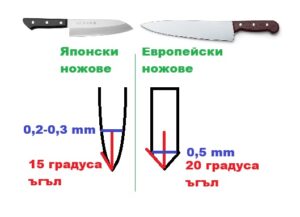
Japanese knives differ from most European knives primarily in their geometry—the primary angles are approximately the same, but the secondary angle —that of the cutting edge—is typically lower on Japanese knives, which allows them to achieve exceptional cutting performance. Naturally, this sharpness requires careful use and maintenance, but it pays off in ease of use and long-lasting sharpness.
In the next article, we’ll provide an overview of the different types of Japanese knives and their uses, and we’ll briefly discuss how to care for Japanese kitchen knives. In a future article, we’ll also cover how to sharpen them.
Stay tuned for Part 2

 LED lanterns
 Fishing Lanterns
 Flashlights for Everyday Use / EDC
 Flashlights that run on AA/AAA batteries
 Lantern Accessories
 Long-range lights
 Powerful Flashlights for Wide-Area Lighting
 Powerful headlamps
 Professional Work Lights
 Tactical Flashlights
 Police Flashlights
 Rechargeable lanterns
 Headlamps with AAA batteries
 Professional Headlamps for Work
 Combat knife
 Fixed Blade Knives
 Camping Knife
 Compact
 Folding Knives
 Automatic knives
 Everyday Knives
 Keychain Knife / EDC
 Large Folding Knives
 Hunting Knives
 Kitchen Knives
 Japanese Kitchen Knives
 Knife Accessories
 Tactical Knives