Blog
Types and Features of Headlamps in 2025

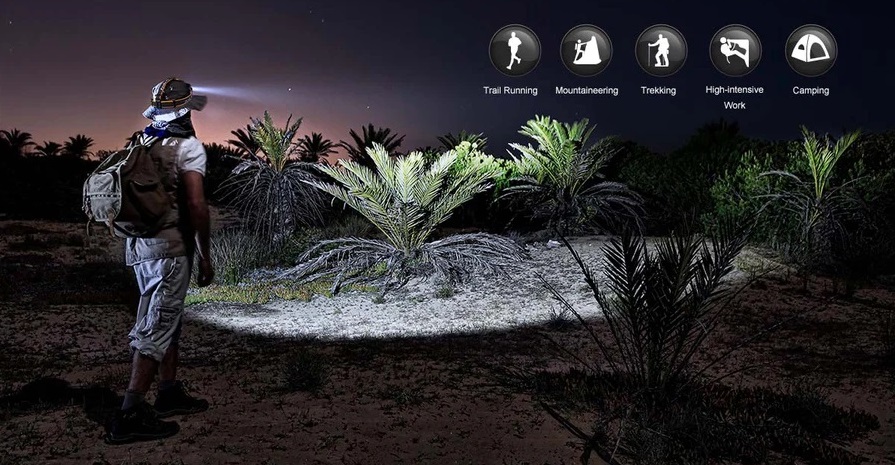
A headlamp is an indispensable accessory for a variety of outdoor activities, working in dark spaces, and everyday use. It keeps your hands free while shining light exactly where you need it.
In this article, we will examine the characteristics of headlamps and the requirements for them in various activities. In the other articles in this section, we will go into more detail about each specific type of headlamp based on the activity for which it will be used.
Features and Requirements for Headlamps for Various Activities
- Long battery life: This is one of the most important factors for most types of LED headlamps. Most activities require sustained lighting at medium settings of around 300–400 lumens, so we strongly recommend paying attention to this feature when making a purchase. Lithium-ion batteries are an excellent choice for headlamps; if they’re the same size as the batteries in your flashlights, even better. Avoid headlamps that use alkaline batteries (AA and AAA). They don’t offer long battery life. You cannot rely on this type of battery. If stored for a long time, they can leak. This can damage the device.
- Controls: A particularly important aspect of a headlamp is how easy it is to switch between modes, whether it can be operated while wearing gloves, how well the modes are designed, whether there is a low-battery warning, a battery level indicator, and so on.
- Weight and Comfort: For extended wear, choose a lightweight headlamp with a comfortable, adjustable strap—ergonomics and comfort are especially important during prolonged use. Keep in mind that the battery often weighs more than the device itself. If the device is heavier and uses a large 21700-type battery, it’s a good idea to have a second battery in the back to balance the weight and extend the runtime. A key factor in the headlamp’s comfort is how it attaches to the head or helmet. The strap should be wide and adjustable, and it’s also good if it’s ventilated so that sweat can evaporate during intense activity.
- Brightness and Light Modes: All modern headlamps use LED lighting because of the higher levels of brightness they can achieve and their energy efficiency. Different activities require different levels of brightness. For example, 50–100 lumens are sufficient for reading in a tent, while at least 300–400 lumens are needed for night climbing. A quick scan of a clearing requires 1,500–2,000 lumens. It’s important to note that higher lumen output in headlamps is only necessary for large industrial headlamps with heavy batteries, because in compact headlamps, high power generates a lot of heat, and no one likes to carry a stove on their forehead.
- Water Resistance: For outdoor activities, it’s important that the headlamp be water-resistant. Look for models with an IPX4 rating or higher. IPX6 models can withstand any storm without a problem, and IPX8 models usually also have ratings for submersion.
- Impact Resistance: Helmets must be impact-resistant and made of durable materials. Even if they are not designed for extreme conditions, they must withstand a fall from the head
- Additional features: Modes such as a flashing light, a red night-vision light, and USB charging can be very useful. Sometimes headlamps have the option to remove the built-in battery and replace it with alkaline batteries, which is good for a backup headlamp or a running headlamp, but not so much for a hiking headlamp. Features such as helmet-mounting hooks or a special helmet mount are very useful on industrial headlamps. There are also some surprising features in high-end headlamps, such as the automatic brightness adjustment in the medium mode of the Fenix HL32R-T, which increases the brightness if you’re running faster thanks to a built-in sensor.
Main Types of Headboards
1. Hiking and Tourism Guides
These headlamps are designed for long-term use and provide a wide, sufficiently bright beam. They typically feature various lighting modes, including a low-brightness setting that conserves battery life and a red light that does not blind others. The system’s efficiency is particularly important, given the difficulty of recharging in certain situations. Reliability must also be high, and for added security, it’s a good idea to pair a headlamp and a flashlight that use the same size batteries (such as 18650), which can be used in both devices. This way, the flashlight can serve not only as a backup but also as a way to carry the spare battery with only a minimal increase in weight.
2. Headlamps for mountaineering, rock climbing, and caving
These headlamps must be extremely reliable and durable, as they are used in extreme conditions. This type is usually the most powerful headlamp with a wide beam angle. Some of our models come with extra batteries. These provide a longer runtime. In certain situations, you may need even more lumens. For example, when exploring caves.
3. Running and Cycling Helmets
These headlamps are lightweight and comfortable, designed to stay securely in place even during intense activity. They are very bright and often include flashing modes for added safety. Lightweight construction is a priority, except when it comes to ultramarathons or bike tours, where longer burn times are needed. Our headlamps feature a magnesium construction, excellent performance at medium brightness levels, an innovative head-mounting system, and a ventilated headband to wick away sweat.
4. Workheadlights
Work headlamps are ideal for construction sites, emergency situations, and any professional activities where lighting is essential. They are typically very durable and feature adjustable brightness. In these cases, low weight isn’t as much of a priority, and the power output is often higher, with high-capacity batteries. A helmet-mounting system is highly recommended.
Some professions require different features—for example, a professional headlamp for an electrician should be compact and doesn’t need to be very bright; instead, a long battery life is more important. Sometimes a headlamp with a sensor is an advantage, so it can be easily turned off even with dirty hands.
5. Headlamps for Fishing and Hunting
These headlamps have specific features, such as a red or green light that does not scare away fish or game. For fishing, there is a specific blue light that helps make fluorescent lines visible. They must also be water-resistant.
6. A headlamp for any situation
It’s always a good idea to keep a small rechargeable headlamp in the glove compartment; if it has a magnet, even better. That way, if needed, you can always use it to change a flat tire at night or for extra light at the campsite or while camping, for example.
- The same applies to the key cabinet in the hallway, so that if a fuse blows, you can see where you’re reaching. It’s important not to store regular AA batteries in it; instead, you can use non-rechargeable lithium or rechargeable lithium batteries, which don’t leak.
In conclusion
Headlamps are an essential tool for a variety of activities, with each type designed to meet specific requirements. When choosing the right model, it is important to consider several factors. Battery life is a key consideration. Comfort and handling are also particularly important. Beam shape and brightness should not be overlooked. Additional features required for the activity are also important.
We must emphasize once again that, when it comes to headlamps, brightness is one of the least important features for the tool to be useful. Whether you’re a hiker, a mountaineer, a fisherman, or use a headlamp for work, choosing the right one can significantly simplify and enhance your activities.

 LED lanterns
 Fishing Lanterns
 Flashlights for Everyday Use / EDC
 Flashlights that run on AA/AAA batteries
 Lantern Accessories
 Long-range lights
 Powerful Flashlights for Wide-Area Lighting
 Powerful headlamps
 Professional Work Lights
 Tactical Flashlights
 Police Flashlights
 Rechargeable lanterns
 Headlamps with AAA batteries
 Professional Headlamps for Work
 Combat knife
 Fixed Blade Knives
 Camping Knife
 Compact
 Folding Knives
 Automatic knives
 Everyday Knives
 Keychain Knife / EDC
 Large Folding Knives
 Hunting Knives
 Kitchen Knives
 Japanese Kitchen Knives
 Knife Accessories
 Tactical Knives