Blog
Headlight Intensity: What It Is and How Important It Will Be in 2025 – Part 2

What determines the brightness of flashlights?
The brightness of flashlights is determined by various factors:
- Light-Emitting Diodes (LEDs): LED technology dominates modern flashlights because it offers high efficiency and low energy consumption. LED flashlights can achieve impressive lumen output, especially when more than one LED is used.
- Battery Type: The power source also affects performance. Lithium-ion batteries provide a stable voltage, which helps achieve high brightness. However, power consumption is high, and this level of brightness requires a lot of battery power.
- Driver—a circuit board that determines how much current from the battery will be transferred to the LED, controls the operating modes, and intelligently adjusts the power output to prevent the flashlight from overheating.
- Reflectors and Optics: The optical components of a flashlight—reflectors, optics, and lenses—direct the light and determine whether it will be concentrated into a narrow beam or spread over a wider area. The choice of specific optics has a significant impact on power efficiency.
- Build Quality: The materials and design of the flashlight's housing also affect heat dissipation and lighting efficiency.
Categories by Power
Lanterns can be divided into different categories based on their power. Here are the main categories:
1. Low-power flashlight (up to 500 lumens):
These flashlights are suitable for everyday use, such as reading or walking in the dark. They are compact and energy-efficient, are usually carried on a keychain, and are very practical. In this category, you can include all compact flashlights under 10 cm that are advertised as having higher wattage, because even if they have the wattage, they lack the battery capacity or size to support it.
Applications:
- Home Lighting.
- Short walks.
- Comfortable to Wear and Lightweight
2. Medium-power everyday flashlights (500–1,000 lumens):
Flashlights in this range are versatile and are often used for outdoor activities, camping, or repair work. They offer a good balance between brightness and battery life. A typical flashlight of this type is about 12 cm long and about 25–28 mm in diameter.
Applications:
- Camping and Tourism
- Carry it in your pocket or bag every day
- Spare flashlight
3. High-powered flashlights (over 1,000 lumens):
Powerful LED flashlights are suitable for users who need brighter or longer-range lighting, but they are also used for professional purposes, such as police flashlights, security flashlights, or tactical flashlights. These are relatively larger flashlights, but they can be carried in a jacket pocket or a flashlight holster, as well as used as a gun-mounted flashlight. The Convoy C8+ flashlight is a typical example of this group; the Dulotec Convoy C8+ Ultra model delivers 2,000 lumens of output and a beam distance of 900 meters. The Dulotec Guardian is also a typical representative of this group, but it is a tactical flashlight with a smaller size and weight, yet featuring a 50% larger battery and additional functions useful for police and tactical applications.
Applications:
- Hunting and Fishing
- Rescue operations.
- Mountaineering and Search and Rescue in Challenging Conditions.
- Security and Tactical Operations.
- Industry
4. Ultra-powerful flashlights (over 5,000 lumens)
These flashlights are designed for professional use and situations requiring a strong light. They are large and typically weigh more than 1 kilogram, so they often include a tripod thread. They aren’t practical for everyday use, but they make excellent industrial flashlights, rescue flashlights, or flashlights for patrolling large areas. In our selection, we’ve made sure to include powerful models that are also long-range flashlights, offering exceptional reliability and a 5-year warranty.
Applications:
- Rescue operations.
- Industry
- Security Services.
How does power affect flashlight applications?
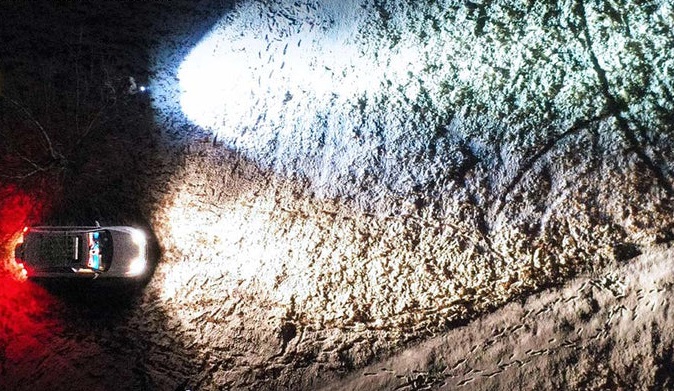
- Illumination Range: Power is not directly related to the illumination range. However, under certain circumstances, higher power helps increase the beam size of long-range lights, meaning that a larger area can be illuminated at the same distance. An example of this is the difference between the Dulotec Convoy C8 and the Dulotec Convoy C8+Ultra. You get the same beam distance, but the Ultra has a 60% larger beam pattern, which requires more power and, consequently, increases battery consumption by 25%. Thus, at 100 m, one model provides a 5 m beam, while the other provides an 8 m beam, with the same level of illumination on the target. This is important for activities such as search and rescue, hunting, or security.
- Beam angle: In general, high output is most easily achieved with more LEDs—this way, they operate at a lower voltage and more efficiently, meaning they produce more light and less heat. However, with more LEDs, it is much more difficult to achieve a long beam distance, which depends mainly on the LED’s illuminated area and the reflector’s diameter. That is why most high-output flashlights have a wide beam angle.
- Operating time: Brighter flashlights often consume more energy, which reduces their operating time. That is why most come with 2–3 or more batteries. This makes it important to strike the right balance between brightness and battery life.
- Compactness and weight: High-powered flashlights are usually larger and heavier, which makes them less convenient to carry in everyday situations. For activities that require extended lighting, it’s also important to consider the weight if you’ll be holding the flashlight in your hand. Extended illumination can also be achieved with a smaller flashlight and spare batteries, which, however, won’t weigh you down.
How do we choose the right flashlight based on its power?
When choosing a flashlight, it is important to consider a combination of factors, which are described in more detail in the sections on the respective activities. Depending on the application, brightness may be a more or less important factor in choosing a flashlight. It must be adequate for the application—if it’s too low, the flashlight won’t be useful enough; if it’s too high, the flashlight becomes large, heavy, and expensive.
To make the right choice, it’s also a good idea to consider factors such as beam distance, size and weight, and runtime (for most brands, there are reviews with graphs showing how the flashlight performs during continuous use), modes, and controls.
For certain types of flashlights, it’s helpful to have specific features, such as a rear button on tactical flashlights, or accessories for mounting under-barrel flashlights to a weapon. An important factor is whether you want a rechargeable flashlight or one where the battery can be removed and charged using a lithium-ion battery charger—and there’s no clear-cut answer as to which is better.
In conclusion
Brightness is one of the key factors to consider when choosing a flashlight for different situations. Brightness is different from beam distance, and choosing a brighter flashlight isn’t always the best solution for a given activity. More powerful flashlights are usually larger and cast a wider beam. More powerful flashlights have their place in hunting, industry, and rescue operations, but even there, it’s best to focus not on peak power (turbo mode values), but rather the sustained light output and lower modes, because that will be the most likely scenario for their use.
Choose carefully, read reviews, look at the performance charts, and be wary of exaggerated claims about super/ultra/mega power to ensure you get the right tool for the job.
 LED lanterns
 Fishing Lanterns
 Flashlights for Everyday Use / EDC
 Flashlights that run on AA/AAA batteries
 Lantern Accessories
 Long-range lights
 Powerful Flashlights for Wide-Area Lighting
 Powerful headlamps
 Professional Work Lights
 Tactical Flashlights
 Police Flashlights
 Rechargeable lanterns
 Headlamps with AAA batteries
 Professional Headlamps for Work
 Combat knife
 Fixed Blade Knives
 Camping Knife
 Compact
 Folding Knives
 Automatic knives
 Everyday Knives
 Keychain Knife / EDC
 Large Folding Knives
 Hunting Knives
 Kitchen Knives
 Japanese Kitchen Knives
 Knife Accessories
 Tactical Knives