Blog
Headlight Intensity: What It Is and How Important It Will Be in 2025 – Part 1

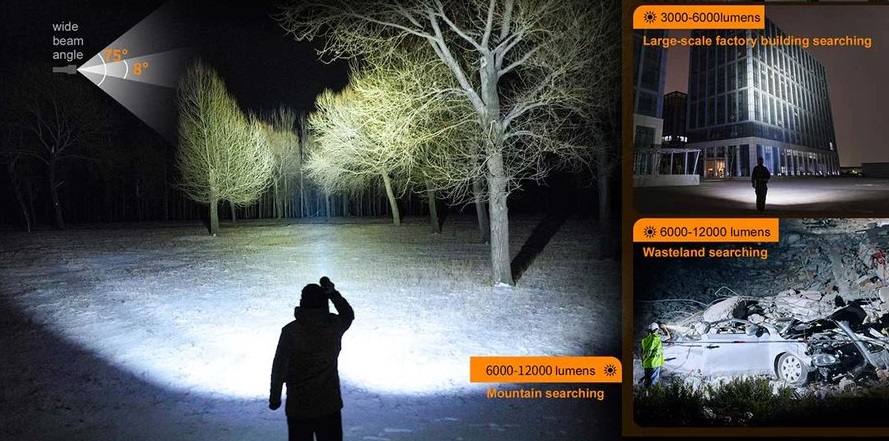
Flashlights are an important part of our daily lives, used in a variety of situations—from emergencies to professional activities and outdoor adventures. One of the key factors to consider when choosing a flashlight is its brightness. In this article, we’ll explore what flashlight brightness means, how it’s measured, how it affects different applications, and how to choose the most suitable model for your needs.
What is the light output of a flashlight, and how does it differ from its beam distance?
The brightness of LED flashlights is usually expressed by the amount of light they emit. It is measured in lumens (lm)—a unit of luminous flux. Lumens indicate how brightly an object or space will be illuminated by the flashlight. A higher lumen rating usually means brighter light, but it should not be considered the primary factor when choosing a flashlight.
People usually look for a powerful flashlight, but what they actually need is a long-range flashlight that shines far. Range is a completely different characteristic; it is measured in candelas (cd) and is not directly related to power. To make a long-range flashlight, it doesn’t need to have a high lumen output.
Various aspects of power are explained below.
How is power measured?
Luminous flux is measured using what are known as integrating spheres—a device that measures only the indirect light from the flashlight, which is reflected off the walls of the sphere, without any direct light from the flashlight falling on the device’s sensor. For their part, the measuring systems themselves are calibrated using a so-called standard bulb to ensure accurate readings.
Interesting fact: We were unable to find an accredited laboratory in Bulgaria that can issue a certificate verifying the power of a given LED flashlight. Furthermore, we were unable to find an accredited laboratory capable of verifying the accuracy with which our various lux meters measure LED light intensity—the meters themselves show differences of over 20% when measuring the same flashlight (even lux meters from the same reputable brand show significant differences).
Lumens are what's being sold, but what are you actually buying?
Because it is difficult to measure brightness, many manufacturers—both past and present—cite unbelievable peak brightness figures—ranging from 100,000 lumens for a pocket flashlight costing 10–20 leva, to figures 20–30% higher for supposedly reputable brands. Years ago, the industry adopted a standard (ANSI/NEMA) for measuring flashlight output, which states that output is measured with the battery installed, 30 seconds after the flashlight is turned on. The reason is that initially, it’s very easy to achieve much higher output, but this generates a lot of heat, and the electronics must quickly reduce it; thus, it is not useful to the consumer, but only to marketers who want to advertise the “King of Power,” “Emperor of Lumens,” and so on. Here’s an example of a flashlight with a similarly useless power rating—it’s advertised as 100,000, but is actually 70,000, and drops to 15,000 within the first minute, meaning that in reality, the consumer gets 15,000–30,000 lumens, but reads an advertisement claiming 100,000. The situation has gotten so out of hand that there were even (fake) calculations circulating online of “lumens per lev.”
Why shouldn't power be treated as an absolute?
Although the principle “the more, the better” applies to flashlights, a flashlight’s performance should be evaluated as a whole. Here are some things to keep in mind:
- More powerful flashlights drain the battery faster
- Higher power generates heat and requires a larger surface area for cooling—that is, larger flashlights. Otherwise, it will only be available for a few seconds, as in the example above. With today’s technology, it’s ridiculous to advertise a small flashlight with 4,000 lumens—even if it exists, it will only last for a few seconds.
- The human eye perceives power nonlinearly. When we design the modes for our flashlights, we include a long-run mode at 30% of the power, but to users it appears to be 90% of the maximum; thus, the heat generated is much less, and the runtime is more than double.
- Just as important as the wattage is the way the light beam is directed—whether through reflectors or optics. In most cases, high-output lights provide a wide beam—you’ll need to decide whether you need to “spread” light 15–20 meters to the sides or if a much lower output focused only ahead is sufficient.
- Powerful flashlights are large and heavy—they require more batteries and space for cooling. This is not only expensive but also makes them impractical to carry around—they’re rarely carried unless being used for work, and they spend most of their time sitting on a shelf.
- Typically, to reduce the brightness and cool down the flashlight, an algorithm is used that measures the temperature and gradually reduces the power. The eye adjusts and does not realize that the brightness has been significantly reduced.
- Design complexity – higher power output places greater demands on the components and assembly; the drivers are more complex, and charging multiple batteries at once also becomes more complicated. More complex designs are generally more prone to failure, so it’s a good idea to thoroughly research the supplier and find out what kind of REAL warranty they offer to avoid ending up with a heavy, expensive brick.

 LED lanterns
 Fishing Lanterns
 Flashlights for Everyday Use / EDC
 Flashlights that run on AA/AAA batteries
 Lantern Accessories
 Long-range lights
 Powerful Flashlights for Wide-Area Lighting
 Powerful headlamps
 Professional Work Lights
 Tactical Flashlights
 Police Flashlights
 Rechargeable lanterns
 Headlamps with AAA batteries
 Professional Headlamps for Work
 Combat knife
 Fixed Blade Knives
 Camping Knife
 Compact
 Folding Knives
 Automatic knives
 Everyday Knives
 Keychain Knife / EDC
 Large Folding Knives
 Hunting Knives
 Kitchen Knives
 Japanese Kitchen Knives
 Knife Accessories
 Tactical Knives